
Some links are affiliate links. If you buy through them, Keeping Backyard Chickens may earn a small commission at no extra cost to you.
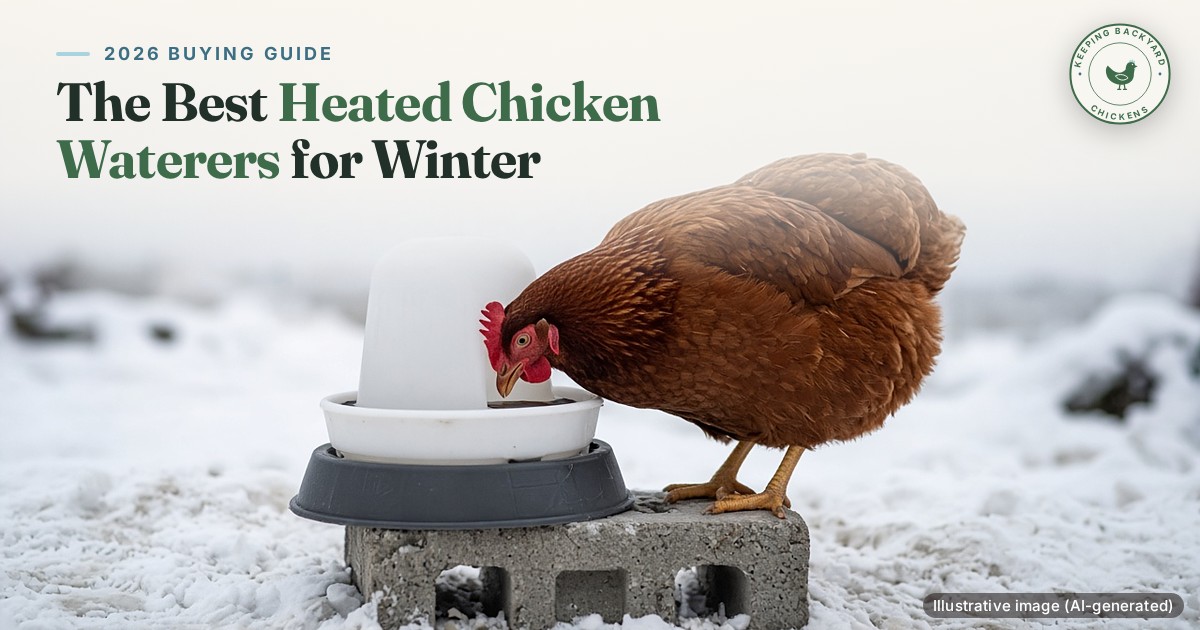
If you’ve ever stood in the coop at 6 a.m. banging a frozen waterer against a fence post, this one’s for you. A good heated waterer is the single piece of winter gear that saves you the most daily hassle, and it keeps your hens drinking, which keeps them eating, laying and staying warm.
Here are the heated chicken waterers worth your money this winter, who each one is for, and the safety basics nobody puts on the box.
Quick picks
- Best overall: Premier 1 Heated Poultry Waterer, 3 gal. Nipple drinker, rated to -20°F, insulated lid.
- Best budget: Farm Innovators HPF-100 Heated Poultry Fountain, 3 gal. Classic open trough your hens already know.
- Best for floor use: K&H Thermo-Poultry Waterer, 2.5 gal. No-roost top and a filter ring.
- Lowest wattage: RentACoop Thermo Bucket Belt. Turns your own bucket waterer into a heated one at 40 watts.
- Best if you own a metal fount: Farm Innovators HP-125 Heated Base.
- Best for a small flock: Farm Innovators HB-60P Heated Drinker, 2 gal. Three nipples, 60 watts.
Pick in 30 seconds
- No power at the coop? Skip all of these. Two rubber pans and a dawn and dusk swap will do it (more on that below).
- Typical winter low below 0°F? Premier 1 (rated to -20°F) or the RentACoop belt with its wrap (rated to -10°F).
- Lows usually between 0°F and 10°F? Premier 1, the RentACoop belt, or the HPF-100 (rated to 0°F). The HP-125 base is only rated to 10°F, and I couldn’t find a published rating for the HB-60P.
- Hens have never used nipples and you don’t want to train them? K&H or the HPF-100, both open founts.
- Already own a double-wall metal fount? The HP-125 base.
- Size: buy at least two days of water. Quick rule: gallons = number of hens divided by 4 (the math is below).
Tracy’s take
If you have power at the coop, I’d buy a nipple waterer and spend a few fall days training the flock. Clean water every day beats scrubbing a trough all winter.
How we chose
I want to be upfront about this: we didn’t run these waterers through a winter ourselves. This list is built on research, not a side-by-side test.
For each waterer, I read the manufacturer’s specs and instructions, checked current retailer listings and prices, and read through owner reviews looking for patterns, especially complaints that show up again and again. I weighed:
- Cold rating: the lowest temperature the maker says it keeps water open
- Wattage: lower draw means a smaller power bill over a long winter
- Thermostat: every pick here only heats when it needs to
- Cleanliness: nipples and no-roost lids keep droppings out
- Capacity and refills: how often you’ll be hauling water in the snow
Prices below are what I saw on October 17, 2026. They change often, especially once winter hits.
Not sure you need a heated waterer at all? Think about two things: how often your water freezes, and whether you can get out to the coop twice a day. If it freezes most nights and your mornings are rushed, a heated option saves a lot of hassle. If hard freezes are rare where you live, swapping waterers may be all you need.
Nipple waterer or open fount: which one?
This is the first decision, and it matters more than the brand.
Nipple waterers keep water sealed inside, so it stays clean for days. Hens peck a little valve to get a drink. The downside is training: birds that have only used open waterers may need a few days to figure them out. Premier 1 suggests putting the new waterer where the old one was, removing other water sources, and tapping a nipple so a hen sees water come out. You only need a few birds to learn it, and the rest follow. In hard wind, nipples can ice over even when the water inside is liquid, so keep them inside the coop.
Open founts and troughs are what most hens grew up with, so there’s no learning curve. They also get dirty fast. Shavings, feathers and droppings end up in the trough, and you’ll be scrubbing every few days.
If your flock is already on nipples, stay with nipples. If not, either train them in the fall before the deep cold, or pick an open fount and plan on more cleaning.
How big a waterer do you need?
Omlet puts an average hen at about a pint of water a day, more in hot weather. University of Kentucky’s feeding guide gives the other rule of thumb: chickens drink about twice as much water as feed by weight. Winter intake is usually a bit lower, but plan on the pint so you’re never caught short.
A pint is an eighth of a gallon, so 8 hens drink about 1 gallon a day. If you want to refill every two days, divide your flock by 4: a 2-gallon waterer suits up to about 8 hens, and a 3-gallon one up to about 12. The “up to 35 birds” ratings on boxes are about how many birds can drink from it, not how often you’ll be refilling.
The best heated chicken waterers for 2026
Premier 1 Heated Poultry Waterer (3 gal): best overall
Our pick
Premier 1 Heated Poultry Waterer, 3 gal
For flocks of any backyard size in very cold climates. Skip it if your hens won’t take to nipples and you don’t want to train them.
This is the one I’d buy for a cold climate. It has a 100-watt heater with a built-in thermostat that turns on at 40°F and off at 60°F, and Premier 1 says it keeps water flowing down to -20°F. The insulated, cone-shaped lid stops hens from perching on top, and a hinged quick-fill cap means you can top it up with a hose or watering can without prying the lid off.
Other details I like: three recessed drip-catch nipples, a 16-foot detachable cord (so you can use it as a regular waterer in summer), and spare nipples in the box. Premier 1 rates it for up to 35 adult birds.
Price seen: $62.00 at Premier 1 Supplies (Oct 17, 2026).
Watch out for: The maker warns the nipples can freeze in direct wind, so keep it inside the coop. A few owners report frozen nipples on single-digit nights even with liquid water inside. It also needs a GFCI-protected outlet, per Premier 1’s instructions.
Farm Innovators HPF-100 Heated Poultry Fountain (3 gal): best budget
Our pick
Farm Innovators HPF-100 Heated Poultry Fountain, 3 gal
For flocks used to a regular plastic fount, in moderate winters. Skip it if you regularly drop below 0°F.
If your hens already drink from a classic plastic fount, this is the heated version of what they know. It holds 3 gallons, uses 100 watts with a thermostat, and Farm Innovators rates it to keep water from freezing down to 0°F. It fills from the bottom and is designed to hang, which helps keep bedding out of the trough.
Price seen: $39.99 at Farm & Home Supply (Oct 17, 2026). It’s also sold at Tractor Supply.
Watch out for: Reviews are mixed. Tractor Supply’s listing showed a 3.3 out of 5 average across more than 800 reviews as of mid-October 2026. The 0°F rating also isn’t as low as the Premier 1. It’s a solid value pick for milder winters, not my first choice for the far north.
K&H Thermo-Poultry Waterer (2.5 gal): best for floor use
Our pick
K&H Thermo-Poultry Waterer, 2.5 gal
For small flocks where the waterer has to sit on the floor. Skip it if you need nipples or more than 2.5 gallons.
K&H makes heated pet beds, and this waterer has some smart touches. The sloped top means nobody roosts on it (and nobody poops in it from above). A removable filter ring in the trough catches shavings and feathers so you can lift it out and tap the gunk away. The spill-proof cap lets you fill it in the kitchen and carry it out full.
It draws 60 watts with a thermostat. K&H says the whole unit is safety certified, and it carries a 2-year limited warranty, which is longer than most here.
Price seen: $79.98 on sale at K&H (list price $114.99) on Oct 17, 2026.
Watch out for: It’s an open trough, so you’ll still clean it more often than a nipple waterer. Only 2.5 gallons.
RentACoop Thermo Bucket Belt: lowest wattage
Our pick
RentACoop Thermo Bucket Belt (Large, 2 to 5 gal)
For keepers who already use a bucket with nipples, or want to build one. Skip it if you want an all-in-one unit.
This one’s different. It’s a heated silicone belt that wraps around the outside of a 2 to 5 gallon bucket, with an insulated wrap over the top. Nothing sits in the water, so there’s no metal to rust. It draws just 40 watts and switches on below 38°F and off at 42°F. RentACoop says it keeps water from freezing down to -10°F when used with the wrap.
It fits buckets 24 to 34 inches around and is meant for nipple-style drinkers. If you don’t have a bucket waterer yet, RentACoop sells bundles with a 5-gallon waterer.
Price seen: $59.95 for the belt, or $117.70 for the belt plus 5-gallon waterer bundle, at RentACoop (Oct 17, 2026).
Watch out for: The listing says to take it off in warm weather. Some reviewers mention cord durability, and it works best on straight-sided buckets.
Farm Innovators HP-125 Heated Base: best if you own a metal fount
Our pick
Farm Innovators HP-125 Heated Base
For keepers with a double-wall galvanized metal fount. Skip it if your fount is plastic.
Already have a galvanized double-wall fount? This heated base sits underneath it and keeps the water open. It uses 125 watts with a thermostat and is rated to 10°F. Farm Innovators says it’s for outdoor use in a dry, covered area.
Price seen: $56.99 at Big R (Oct 17, 2026).
Watch out for: It only works with double-wall metal founts, not plastic ones. The 10°F rating is the warmest on this list, and at 125 watts it’s also the hungriest. Metal founts are heavy and still collect bedding, so set it on a block.
Farm Innovators HB-60P Heated Drinker (2 gal): best for a small flock
Our pick
Farm Innovators HB-60P Heated Drinker, 2 gal
For flocks of 4 to 10 hens already used to nipples. Skip it for big flocks or if you hate frequent refills.
A smaller, simpler nipple bucket. It holds 2 gallons, uses a 60-watt thermostatically controlled heater, and has three side-mounted nipples that Farm Innovators says serve up to 15 chickens. It has a metal handle for hanging, and the top lifts off to refill.
Price seen: $51.01 at Shell Lumber (Oct 17, 2026). Other retailers listed it in the mid-$40s to mid-$60s at the time.
Watch out for: Two gallons goes fast with a bigger flock, so expect to refill every couple of days. I couldn’t find a published minimum temperature rating for this model.
What each one costs to run
These are worst-case numbers, as if the heater ran 24 hours a day, at the 2026 U.S. average home electricity price of about 18.2 cents per kWh (EIA). The thermostat means real costs land well below this.
| Waterer | Watts | kWh per day (worst case) | Cost per 30 days (worst case) |
|---|---|---|---|
| RentACoop Thermo Bucket Belt | 40 | 0.96 | $5.24 |
| K&H Thermo-Poultry, Farm Innovators HB-60P | 60 | 1.44 | $7.86 |
| Premier 1, Farm Innovators HPF-100 | 100 | 2.4 | $13.10 |
| Farm Innovators HP-125 base | 125 | 3.0 | $16.38 |
| For comparison: a 250-watt heat lamp, 12 hours a night | 250 | 3.0 | $16.38 |
On a dry, sunny winter day in a place like Reno, where a normal January runs from 26°F at night to 48°F in the afternoon (NOAA normals), a thermostat like Premier 1’s (on at 40°F, off at 60°F) is off for much of the afternoon and on overnight. That’s a big reason real bills come in under the table. Nipples are the weak spot on windy nights, so keep the waterer inside the coop.
Skip this
- A heat lamp aimed at the waterer. University of Maryland Extension warns that cold water splashed on a hot bulb can shatter it, and you’re back to the fire risk you were avoiding.
- Running it on an indoor extension cord all winter. UMN Extension says extension cords are for short-term use only. Use an outdoor-rated cord for now and plan on an electrician.
- A plastic fount on a metal heated base. The HP-125 is made for double-wall metal founts only.
Safety basics for any heated waterer
A heated waterer is far safer than a heat lamp, because it only needs to keep water above freezing and most turn off once it’s warm enough. Still, it’s electricity near water, bedding and curious birds. A few rules:
- Use a GFCI outlet. Premier 1’s instructions require one. It cuts power if there’s a fault.
- Use an outdoor-rated cord, and not as a permanent fix. University of Minnesota Extension says extension cords should only be short term and recommends an electrician for running power to a coop.
- Keep cords away from beaks and bedding. Run them up high or through conduit.
- Get it off the floor. Set it on a cinder block or paver, or hang it. Water stays cleaner and the heater stays out of the shavings.
- Skip the DIY lightbulb heaters. Homemade cookie-tin or bulb setups are basically small heat lamps.
No power at the coop? Your options
You can absolutely do winter without electricity. It just takes more trips. UNH Extension suggests low rubber buckets or pans you can flip over, knock the ice out of, and refill. Keep two and swap them morning and evening, carrying fresh water out each time. Ohio State recommends changing water at least twice a day in winter and checking it in the evening so birds have water all night.
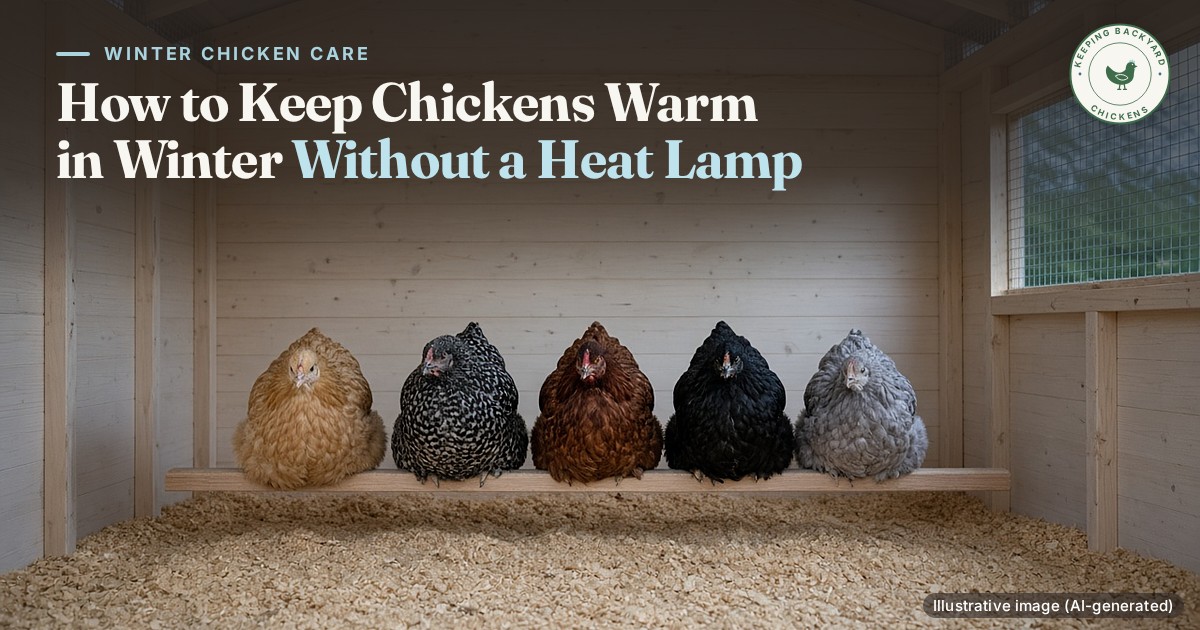
For everything else on keeping your flock comfortable (bedding, roosts, ventilation and why the heat lamp should stay in the box), read how to keep chickens warm in winter without a heat lamp. And for the full prep list, see how to winterize a chicken coop.
FAQ
Do heated chicken waterers make the water warm?
No. They’re designed to keep water from freezing, not to warm it. Premier 1 says the water in its heated waterer doesn’t get hot, or even warm.
How much electricity does a heated chicken waterer use?
The ones on this list draw 40 to 125 watts and all use a thermostat. Worst case, running nonstop, that\’s about $5 to $16 a month at the 2026 U.S. average electricity price. Real costs are lower because the heater cycles off whenever it\’s warm enough. See the cost table above.
Can I use a heated waterer in summer?
Some, yes. The Premier 1 has a detachable cord, and Farm Innovators markets the HPF-100 for year-round use. RentACoop says to remove its bucket belt in warm weather.
Why are my nipple waterer’s nipples freezing when the water isn’t?
Usually wind. Premier 1 says freezing nipples with liquid water inside are typically caused by wind or a draft, and recommends keeping the waterer somewhere protected on all sides.
How many heated waterers do I need?
One good 3-gallon waterer covers most backyard flocks. UMN suggests keeping a spare waterer on hand in case one freezes or quits, which is smart in any cold climate.
Are heated dog bowls okay for chickens?
They can work. UMN lists them as an option, but recommends partially covering them so birds can’t step in or drown.
Featured image: illustrative (AI-generated).

Leave a Reply