

Some links on this page may become affiliate links. If you buy through one, I may earn a small commission at no extra cost to you.
Walk into any farm store in October and you’ll see the heat lamps stacked by the door. Skip them. Most healthy, fully feathered chickens don’t need added heat, and heat lamps are a well-known cause of coop fires. The Kansas fire marshal’s office tracked 164 heat lamp fires in that state from 2015 to 2024.
What a flock does need in winter is pretty simple: a dry coop, no drafts where they sleep, fresh air up high, unfrozen water, plenty of feed and a coop predators can’t get into. This list covers the supplies that help with each of those, plus a few you can skip.
A quick note on how this list was made: these picks are based on extension guidance and manufacturer specs, not a side-by-side test in our own coop. Prices change a lot once winter hits, so check before you buy.
The short list
- Deep, dry bedding (pine shavings or straw)
- A plan for unfrozen water (rubber pans or a heated waterer)
- Hardware cloth for vents and windows
- A thermometer with a humidity reading for the coop
- Predator-proof latches
- An automatic coop door (nice to have)
- A windbreak for the run
- A poultry first-aid kit
Buy for your coldest normal low
Not every flock needs every item. Match the list to how cold your winters actually get (the waterer ratings are the makers’ own; see the heated waterer guide for details):
| Your typical winter low | Water | Also worth it |
|---|---|---|
| Above 20°F | Rubber pans and a twice-daily swap. A heated base (the HP-125 is rated to 10°F) if mornings are rushed. | Bedding, hardware cloth, a windbreak |
| 0°F to 20°F | A heated waterer (the Farm Innovators HPF-100 is rated to 0°F) | Thermometer-hygrometer, extra bedding, two-step latches |
| Below 0°F | Premier 1 (rated to -20°F) or the RentACoop belt with its wrap (-10°F), plus a spare pan | Deep litter, covered insulation, a solid windbreak |
Tracy’s take
Spend on water and hardware cloth first. Frozen water and predators are the two winter problems a coop can’t fix on its own, and everything else on this list is cheaper or optional.
Bedding and roosts
1. Large-flake pine shavings or straw (any brand)
Bedding does most of the work of keeping a coop dry. Ohio State recommends 4 to 6 inches, and lists pine shavings, straw, wood chips and shredded paper as options. Stir it every few days, add a fresh layer as it packs down, and pull out wet spots around the waterer right away.
Good to know: Skip cedar shavings, which give off strong aromatic oils. Hay can hold moisture and mold, so straw is the better pick if you go that route. Your local feed store usually has the best price on both.
How much to buy: coop floor in square feet times 0.5 gives cubic feet for a 6-inch layer. A 4×8 coop needs about 16 cubic feet. Compressed bales list their expanded volume on the bag. In dry climates, pick large-flake, low-dust shavings; fine shavings break down into dust fast.
2. A wide, flat roost (a 2×4 works)
Hens cover their toes with their feathers when they roost on a wide, flat surface, which helps prevent frostbite. A plain 2×4 with the wide side up is all you need. Wood stays warmer than metal or plastic.
Good to know: Nothing to buy if you have scrap lumber. Sand any rough edges so there are no splinters.
Water
3. Rubber feed pans (for the swap method)
The cheapest way to beat frozen water: keep two rubber pans, and trade the frozen one for a fresh one morning and evening. Rubber flexes, so the ice pops right out. UMN also suggests keeping a spare waterer on hand in case one freezes or fails.
Good to know: This only works if you can get out to the coop twice a day.
Sunny winters? University of Maryland Extension suggests black rubber tubs set in the sun: they soak up heat, won’t crack, and the ice pops out easily. That works especially well in dry, sunny places where the water freezes at night and thaws by afternoon.
4. A heated waterer or heated base
If water freezes most nights, a thermostat-controlled heated waterer saves a lot of hassle. We compared six of them, from about $40 to $80, in our heated chicken waterer guide.
Good to know: Plug it into a GFCI outlet, keep cords up high and away from beaks and bedding, and treat an outdoor-rated extension cord as a short-term fix. An electrician can run permanent power to the coop.
Air and moisture
5. A thermometer-hygrometer for the coop
Damp air, not cold air, is what makes frostbite more likely. A small digital thermometer that also reads humidity tells you whether your ventilation is keeping up. If humidity stays high overnight, open the vents up high a little more and check for wet bedding.
Good to know: A Bluetooth model like the Govee H5075 lets you check readings from the house without opening the coop. Keep it out of pecking reach.
6. A windbreak for the run
A tarp or clear plastic sheet on the windward side of the run gives hens a place to get out of the wind on sunny winter days. Leave a gap at the top for airflow.
Good to know: Clear heavy snow off any run cover so it doesn’t sag or collapse. Any hardware store tarp works.
Predator-proofing
7. 1/2-inch welded hardware cloth
Predators get bolder when food is scarce. Cover every vent and window with welded hardware cloth, fastened with screws and washers rather than staples. Chicken wire keeps chickens in, but it won’t keep raccoons out, and weasels can slip through it. The Extension Foundation has a good overview of predator-proofing.
Good to know: A small roll from any hardware store covers most vents. Wear gloves when you cut it; the edges are sharp.
8. Two-step latches (or a carabiner)
Raccoons can open simple hook-and-eye latches and slide bolts. A latch that needs two separate motions, or a spring-loaded carabiner clipped through the latch, stops them.
Good to know: Cheap and quick. Check every door and the egg box lid.
9. An automatic coop door (nice to have)
A door that closes at dusk on a light sensor or timer means the flock is locked in even when you get home late on a dark winter evening.
Good to know: Popular options include the Run-Chicken door, the Omlet Autodoor and ChickenGuard. Check that the model you pick is rated for your coldest temperatures, and still do a head count at night.
Health
10. A basic poultry first-aid kit
Winter brings its own problems: pecking when birds are cooped up, frostbite, and the occasional cut. A simple kit with gloves, a wound spray made for poultry, gauze, vet wrap and a small dog crate for separating a hurt bird covers most of it.
Good to know: Vetericyn Plus Poultry Care is a common wound spray. For frostbite, don’t rub the area or warm it quickly, and call a vet who sees poultry if you’re worried.
The power-outage kit
Electric gear fails at the worst moment: the coldest night, in a storm. Ohio State notes that birds that have been kept warm and then lose heat are worse off than birds that never had it, which is one more reason not to start a heat lamp habit. Keep these where you can find them in the dark:
- Two rubber pans (they need no power at all)
- A headlamp with fresh batteries
- Feed for at least a week. UMN says flocks can eat up to 25% more in the cold.
- A spare bag or bale of bedding
- A dog crate for a bird that needs a sheltered night in the garage
What to skip
- Heat lamps. Fire risk, and they leave birds less adapted to the cold.
- Sealing the coop tight. Block drafts at roost level, but keep vents open up high.
- Uncovered insulation. Chickens will peck at it. If you insulate, cover it.
- Big treat rations. A small handful of scratch in the late afternoon is plenty; most of their diet should still be layer feed.
What about a coop heater?
Most flocks don’t need one. UNH and Ohio State say healthy, acclimated birds handle cold well, while UMN suggests adding heat if the coop drops below about 35°F. If you have bantams, sick or molting birds, or truly extreme cold and decide to add heat, a flat radiant panel made for coops (such as the Sweeter Heater or Cozy Products coop heaters) is a much lower fire risk than a heat lamp. Mount it securely, follow the clearance instructions, keep it away from bedding, and plug it into a GFCI outlet. The goal is to take the edge off, not to make the coop warm.
For the full picture, read how to keep chickens warm in winter without a heat lamp and how to winterize a chicken coop.
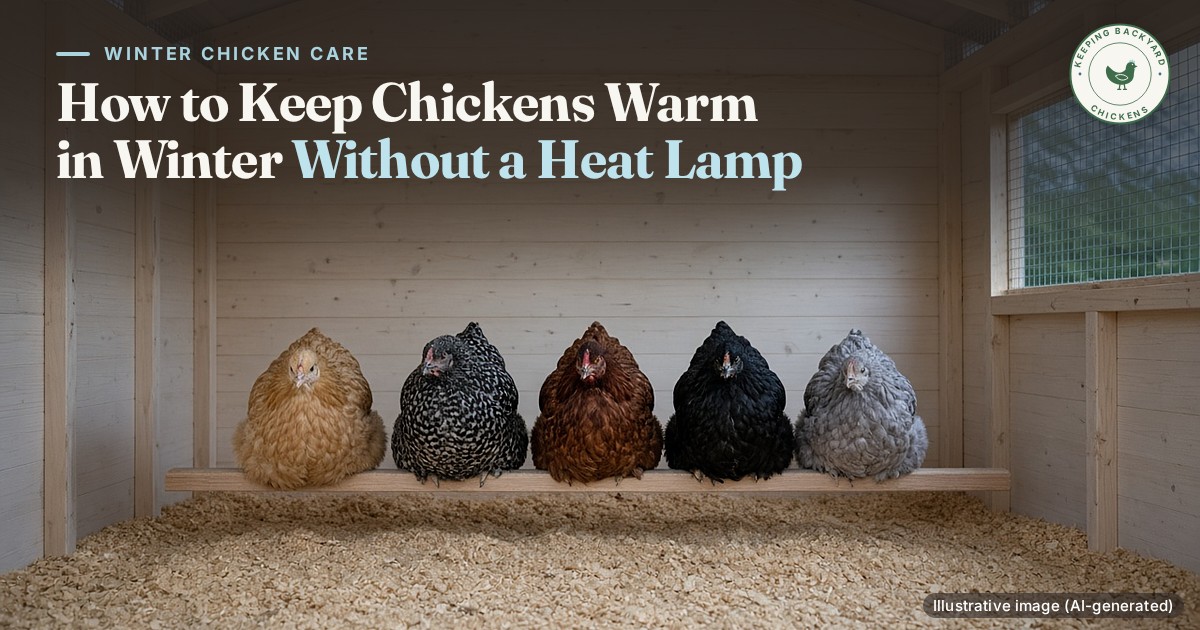
Featured image: illustrative (AI-generated).

Leave a Reply